Securing an international education becomes seamless through the competitive national merit scholarship framework at Sapienza University of Rome. This premier funding system ranks applicants globally based on prior GPA scores, academic distinctions, and entry evaluations. By aligning institutional awards with regional DiSCo Lazio grants, the national merit scholarship pathway removes financial barriers by providing full tuition exemptions and comprehensive living stipends to the world’s most talented minds.
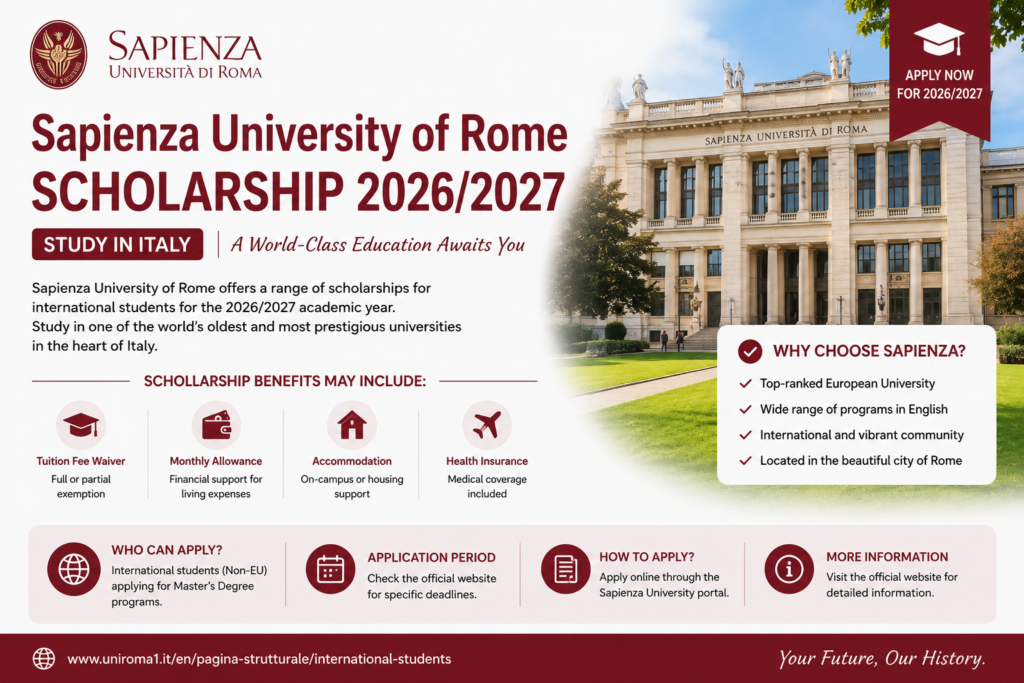
Program Summary Table
| Category | Details |
|---|---|
| Host Institution | Sapienza University of Rome (Sapienza Università di Roma) |
| Location | Rome, Lazio, Italy |
| Academic Year | 2026/2027 Intake |
| Degree Levels | Bachelor’s, Master’s, and PhD Degrees |
| Funding Status | Fully Funded Options Available (Tuition + Stipend + Housing) |
| Primary Scholarship Schemes | DiSCo Lazio Regional Grants, Sapienza Merit Awards, Italian Government (MAECI) |
| Core Selection Metric | Academic excellence matching the national merit scholarship criteria |
| Instruction Languages | English and Italian (Over 60+ complete programs in English) |
| Application Deadlines | Non-EU Applicants: 15 May 2026 EU Applicants: 31 July 2026 |
| Application Portal Fee | €30 to €35 per chosen degree program |
Also check out: Marshall & Rhodes Scholarships
Detailed Financial Benefits and Funding Framework
Studying in Rome can be financially demanding without institutional support. Fortunately, the funding architecture at Sapienza University of Rome completely transforms this equation. By aligning local institutional support with the Italian national merit scholarship standards, the financial packages ensure comprehensive coverage across multiple pillars.
1. Full Tuition Fee Exemption
Selected scholars are completely exempt from paying standard university tuition fees, which can otherwise range from €1,000 to €3,000 per academic year. Recipients only pay a nominal regional education tax and a small stamp duty (typically around €140 to €156 total per year).
2. Annual Living Allowances (Stipends)
The financial backbone of this program is an annual cash stipend, typically structured through the DiSCo Lazio regional framework and national funding streams:
- Off-Site Students (International/Non-Resident): Receive up to €7,000 to €8,000 per year, distributed in two distinct instalments.
- Commuter Students: Receive a modified stipend (approx. €3,500 to €4,000) if residing closer to the Lazio perimeter.
- This cash allowance is heavily protected under national merit scholarship laws. Students must maintain a minimum number of university credits (CFU) each semester to guarantee the continuous release of their funds.
3. Subsidised or Free Accommodation
Finding private housing in Rome is notoriously difficult and expensive. Winners of the fully funded track gain access to:
- Free placement in official DiSCo Lazio student halls of residence scattered across Rome.
- Alternative monthly rental allowances (housing vouchers) if campus rooms reach full capacity.
4. University Dining Vouchers
To address basic cost-of-living requirements, the funding incorporates free or heavily subsidised daily meals at official university canteens (Mensa). Students receive digital meal tokens or QR codes linked to their student profile, ensuring access to healthy, balanced meals between lectures.
5. National Health Insurance Coverage
International students from non-EU countries receive comprehensive health coverage through registration with the Italian National Health Service (Servizio Sanitario Nazionale or SSN). This gives students full access to general practitioners, public hospital care, emergency services, and subsidised prescription medicines at nominal local rates.
Comprehensive Study Fields (English-Taught Majors)
Sapienza University offers an extensive array of English-taught programs. To make browsing easy, these majors are categorized below by academic department, presented one by one with their core focus areas.
Computer Science & Advanced Technology
- Artificial Intelligence: Covers machine learning, neural networks, computer vision, and cognitive computing.
- Robotics: Combines hardware engineering with intelligent software to design autonomous systems.
- Computer Science: Explores foundational computing theories, advanced algorithms, and system architectures.
- Cybersecurity: Targets network defense, ethical hacking, digital forensics, and data privacy systems.
- Data Science: Specialises in big data analytics, statistical modelling, and predictive business intelligence.
- Applied Computer Science: Focuses on practical software engineering and building real-world digital solutions.
Engineering & Industrial Technologies
- Biomedical Engineering: Integrates engineering principles with biological sciences to design healthcare technologies and medical devices.
- Chemical Engineering: Focuses on raw material conversion, industrial chemical production processes, and molecular transformation.
- Control Engineering: Studies automation, feedback loops, and mathematical models to control dynamic machinery systems.
- Electrical Engineering: Covers large-scale electrical power systems, power generation, grid networks, and smart energy distribution.
- Electronics Engineering: Targets microchips, semi-conductors, embedded circuits, and electronic communication hardware design.
- Energy Engineering: Deals with renewable power systems, fossil fuel efficiency, green energy transition, and thermal dynamics.
- Management Engineering: Merges industrial engineering logistics with corporate strategy, supply chains, and project optimization.
- Mechanical Engineering: Explores structural mechanics, materials science, machine design, and advanced robotics manufacturing.
- Nanotechnology Engineering: Focuses on manipulating matter at the molecular or atomic scale to innovate smart nanomaterials.
- Telecommunication Engineering: Targets signal processing, fiber optics, wireless networks, and 5G/6G global communications.
- Aerospace and Astronautical Engineering: Deals with aircraft design, orbital mechanics, satellite systems, and space exploration tech.
- Sustainable Building Engineering: Focuses on green architecture, eco-friendly structural design, and civil energy efficiency.
- Transport Systems Engineering: Targets urban mobility networks, public transport infrastructure, and traffic management logistics.
- Environmental Engineering for Climate Change: Focuses on waste management, water purification systems, and infrastructure design resistant to climate emergencies.
- Green Industrial Engineering for Sustainable Development: Combines industrial production logistics with eco-friendly manufacturing technologies to lower carbon footprints.
Medicine, Psychology & Health Sciences
- Medicine and Surgery: A continuous, 6-year single-cycle medical program covering professional clinical training and diagnostics.
- Bioinformatics: Merges biology with computer algorithms to analyze genetic data sequences and complex biological pathways.
- Nursing: Focuses on clinical nursing practices, patient healthcare management, and public health systems.
- Cognitive Neuroscience: Explores brain functions, neurological mapping, memory processes, and biological psychology.
- Clinical Psychosexuology: Specialises in psychological diagnostics, sexual health, clinical therapy, and counseling systems.
- Molecular Biology: Focuses on cellular life functions, DNA replication, gene expression, and modern biotechnology.
- Medicinal Chemistry: Concentrates on pharmaceutical discovery, drug design, synthesis, and chemical biomedical development.
- Biochemistry: Examines the chemical processes occurring inside living cells and biological molecular structures.
- Applied Dynamic and Clinical Psychology: Focuses on psychodynamics, clinical assessment methodologies, and psychological intervention strategies.
- Cognitive Forensic Sciences: Studies the intersection of legal systems, criminal investigations, and cognitive psychological analysis.
Natural, Physical & Mathematical Sciences
- Physics: Covers quantum mechanics, theoretical physics, astrophysics, and basic physical forces of nature.
- Atmospheric Science: Analyzes weather patterns, climate dynamic theories, atmospheric chemistry, and weather forecasting.
- Meteorology & Climate: Investigates global climate changes, greenhouse patterns, meteorological systems, and severe weather data.
- Astrophysics and Cosmology: Investigates deep-space phenomena, stellar evolution, and the origin theories of the universe.
- Mathematical Sciences for Artificial Intelligence: Combines advanced mathematical proofs, calculus, and linear algebra optimized for building AI architectures.
- Statistical Methods and Applications: Covers computational statistics, data tracking models, and probability systems for demographic analytics.
- Actuarial and Financial Sciences: Uses mathematical and statistical models to assess risk in insurance, finance, and investment industries.
Business, Economics & Management
- Business: Focuses on corporate administration, organizational behavior, marketing strategies, and startup growth.
- Economics: Explores macro/microeconomic models, market behaviors, international trade policies, and economic systems.
- Finance, Insurance: Covers asset management, corporate investments, risk forecasting, and insurance metrics.
- Health Economics: Applies economic principles to the resource allocation of healthcare delivery, hospitals, and pharmaceutical policy.
- Hospitality Management: Targets tourism corporate structures, luxury resort administration, and global leisure industry frameworks.
Architecture, Arts & Humanities
- Architecture: Focuses on urban regeneration, spatial structures, structural design history, and building preservation.
- Product Design: Focuses on industrial product design, creative manufacturing systems, and sustainable user-centered products.
- Service Design: Concentrates on strategic service layouts to improve civic experiences and public utility interactions.
- Classics: Explores ancient Greek and Roman literature, history, philology, and classical world languages.
- Global Humanities: Focuses on intercultural histories, anthropological studies, and global social developments.
- English and Anglo-American Studies: Examines English literature, global linguistics, and structural cultural histories.
- Mediterranean Archaeology: Investigates ancient civilisations, material excavation remains, and architectural conservation.
- Architecture – Urban Regeneration: Concentrates on modernizing older city layouts, sustainable town planning, and eco-friendly structural design.
Social Sciences, Law & Culture
- European Studies: Covers EU corporate laws, institutional policies, European integration, and international diplomacy.
- Development and International Cooperation: Focuses on global development models, foreign aid coordination, and international resource strategies.
- Political Sciences: Studies governance systems, political theories, international relations, and legislative public policy.
- Gender Studies: Investigates cultural, political, and social dynamics surrounding gender identities and equality systems.
Detailed Eligibility Requirements
To qualify for the funding packages at Sapienza University of Rome, candidates must fulfill a set of academic, financial, and administrative criteria. This framework ensures that allocations match the rigorous expectations of an international national merit scholarship profile.
1. Nationality and Regional Inclusivity
- International Applicants: Citizens of any non-Italian nation (both EU and non-EU) are fully eligible.
- Domestic Applicants: Italian citizens can apply, provided their family home location meets the minimum commuting distance requirements established by regional funding offices.
2. Prior Academic Credentials
- For Bachelor’s Degrees: Applicants must possess a valid high school diploma representing at least 12 complete years of continuous schooling. This diploma must grant access to university education in the home country.
- For Master’s Degrees: Applicants must hold an accredited Bachelor’s degree (minimum 3 years of duration) in a field directly relevant to the selected Master’s curriculum.
- For PhD Positions: Candidates must hold a globally recognized Master’s degree with a documented history of research output or an outstanding final thesis evaluation.
3. Merit and GPA Thresholds
Because funding is heavily benchmarked against the standard national merit scholarship metrics, your academic record is paramount:
- Candidates should possess a cumulative GPA equivalent to the top 15% to 20% of their graduating cohort.
- Backlogs, multiple failed courses, or prolonged extensions in previous degree completion can negatively impact your ranking score during the initial application sort.
4. Language Proficiency Prerequisites
Since the courses highlighted above are taught exclusively in English, you must prove your language proficiency:
- IELTS Academic: Minimum overall score of 6.0 or 6.5 (B2/C1 CEFR equivalency depending on the program).
- TOEFL iBT: Minimum score of 80.
- English Medium of Instruction (MOI) Certificate: Accepted only if your entire previous degree was taught at an institution in an English-speaking country, or if the specific Sapienza faculty explicitly lists it as an acceptable alternative during pre-selection.
5. Socio-Economic Status (ISEE Parificato)
While academic rankings determine your eligibility for merit-based awards, your financial need determines the total amount you receive from regional funding (DiSCo Lazio). Students must calculate an ISEE Parificato index score through an official Italian tax assistance centre (CAF). An ISEE score below €25,000 per year qualifies you for the highest tier of living stipends and free housing allocations.
Required Documents Checklist
All documents must be uploaded digitally via the Sapienza portal in clear, legible PDF formats. Documents written in languages other than English or Italian must be accompanied by an official, sworn translation.
- Valid International Passport: Must show biometric pages with at least 18 to 24 months of remaining validity.
- Curriculum Vitae (CV): Formatted preferably in the standardized Europass CV style, detailing academic history, research projects, publications, and relevant internships.
- Academic Transcripts: Complete semester-by-semester grade sheets from your high school or university, indicating clear cumulative GPA scores and grading scales.
- Graduation Certificate / Diploma: Final degree scroll or provisional graduation certificate issued by your alma mater.
- Motivation Letter: A tailored, 1-page personal statement explaining your choice of major, your career objectives, and why you deserve a national merit scholarship position at Sapienza.
- Letters of Recommendation: Two references signed and stamped by university professors or senior research supervisors on official institutional letterhead.
- English Language Proficiency Certificate: Valid IELTS, TOEFL, or official institutional confirmation of prior English-medium instruction.
- Syllabus / Course Description Document: (Required for specific engineering and science Master’s degrees) A brief outline detailing the exact contents of the courses passed during your Bachelor’s degree. This helps the admissions committee verify prerequisites.
Step-by-Step Application Guidelines
Navigating the application process for Sapienza University national merit scholarship requires close attention to detail, as you must coordinate both academic admission and financial aid applications. Follow this breakdown step-by-step to protect your eligibility.
Step 1: Course Selection and Faculty Review
Visit the official Sapienza course listing directory. Identify the exact English-taught program that matches your academic background. Read the specific “Call for Applications” (Bando) for that individual major, as entry tests or varying cut-off dates may apply.
Step 2: Account Creation on the Infostud Portal
The Infostud system is Sapienza’s centralized administrative network. Create a personal profile by entering your correct demographic details as they appear on your passport. The portal will generate an official Student ID number (Matricola), which will track your application throughout the process.
Step 3: Complete Pre-Selection Forms and Upload Documents
Log in to your program’s admission dashboard. Complete the required digital profile questionnaires and upload your prepared PDF documents (Transcripts, CV, Motivation Letter, and Certificates) into their respective slots.
Step 4: Remit the Application Processing Fee
Generate the official payment slip via the Infostud portal. Pay the mandatory non-refundable application fee (typically €30 to €35 per program) using an international credit card or the integrated PagoPA secure electronic payment network. Your profile will not proceed to faculty review until this fee is processed.
Step 5: Interview and Entrance Evaluations
If your academic profile aligns with the required standards, the admissions committee may invite you for a virtual technical interview via Microsoft Teams or Skype. These sessions evaluate your domain knowledge, research goals, and communication skills.
Step 6: Secure Your Pre-Acceptance Offer Letter
Successful applicants will receive an official pre-acceptance notification via email and the Infostud platform. Non-EU applicants must immediately upload this document to the Italian government’s Universitaly Portal to initiate their student visa processing.
Step 7: Apply for the Regional DiSCo Lazio Scholarship
Once pre-admitted, you must submit a separate application on the official DiSCo Lazio portal (usually opening between June and July). Enter your family financial details, submit your translated income certificates, and link your profile to your Sapienza ID to secure your free housing, tuition waivers, and cash stipends.
Official Website and Application Portals
You can access the relevant platforms and submit your applications through the following official direct links:
- To Review Programs and University Policies: Visit the Sapienza University International Admissions Portal.
- To Register and Pay Application Fees: Access the Sapienza Infostud System.
- To File for Living Allowances and Housing Vouchers: Visit the DiSCo Lazio Regional Funding Portal.
- To Apply for Your Entry Visa (Non-EU Students): Complete your registration via the Italian Ministry Universitaly Portal.
Frequently Asked Questions (FAQ)
H4: What exactly constitutes a national merit scholarship inside the Italian public university framework?
A national merit scholarship is a government-regulated funding framework designed to award financial aid, full tuition waivers, and monthly stipends to students who demonstrate exceptional academic achievement, high GPAs, and consistent semester credit accumulation.
H4: Is Sapienza University of Rome a private or public institution?
Sapienza is a public research university. This status allows its degree courses and regional scholarship programs to be heavily subsidized by the Italian state and European Union educational budgets.
H4: Can I submit applications for multiple English-taught majors simultaneously?
Yes, you can apply for up to two or three distinct degree programs per cycle. However, you must pay the independent processing fee for each selection track.
H4: Is there an absolute requirement to provide an IELTS score if my high school was English-medium?
While some faculties accept an official English Medium of Instruction (MOI) certificate, most highly competitive science and technology tracks strongly prefer a formal IELTS or TOEFL score to maintain a fair ranking process.
H4: What is the minimum required score on the IELTS to clear pre-selection?
An overall band score of 6.0 is the minimum baseline across most programs. However, specific competitive tracks like Artificial Intelligence or Medicine prefer an overall score of 6.5 or higher.
H4: What does the term “ISEE Parificato” represent for international student evaluations?
The ISEE Parificato is an official financial index certificate that measures your family’s global economic status, assets, and annual income. It translates your home country’s financial realities into standard Italian economic metrics to determine your eligibility for need-based grants.
H4: Does the scholarship pay out my monthly stipend money immediately upon my arrival in Rome?
No. The first financial installment is typically paid out in December or January after the university verifies your official physical enrollment and attendance. You should bring sufficient personal savings to cover your initial two to three months of living expenses.
H4: Can I apply for the Sapienza 2026 intake if I am currently in my final semester of undergraduate studies?
Yes, you can apply using your current, up-to-date intermediate transcripts. If selected, you will receive a conditional offer letter requiring you to submit your final diploma before autumn enrollment closes.
H4: Are there age limits for international applicants seeking the DiSCo Lazio merit grant?
No, there are no age restrictions for standard Bachelor’s and Master’s degree allocations, making this an ideal path for non-traditional students and returning professionals.
H4: Do I have to apply for my entry student visa directly through Sapienza University?
No. While Sapienza provides your pre-acceptance letter, your official visa application must be submitted through the Italian government’s Universitaly portal and processed by the local Italian Embassy or Consulate in your home country.
H4: Can I work part-time in Rome while holding a fully funded scholarship?
Yes. Italian student visa laws permit international students to work part-time for a maximum of 20 hours per week.
H4: What happens if I fail to pass my exams during my first year at Sapienza?
To maintain your funding under the national framework, you must earn a specific number of university credits (CFUs) by August 10th of each academic year. Failing to meet this threshold will result in the suspension of your stipend and housing allocations.
H4: Does the scholarship cover my round-trip international flight tickets?
The standard regional scholarship does not cover international flights. It focuses on local expenses like tuition, housing, daily meals, and public transport inside Rome.
H4: Is learning the Italian language a mandatory requirement for graduation?
If your program is registered as an English-taught major, all lectures, exams, and thesis presentations are conducted in English. However, learning conversational Italian is highly recommended for daily life and local internships.
H4: What is the exact difference between EU and Non-EU application tracking timelines?
Non-EU applicants face an earlier deadline (15 May) because they require additional time to complete embassy pre-enrolment and visa processing. EU citizens have until late July since they enjoy visa-free entry.
H4: Can I change my major midway through the academic year while retaining my financial aid?
Changing your major requires a formal application to the faculty board and a reassessment of your scholarship status. It can disrupt your credit tracking and may cause you to lose your funding for that transition semester.
H4: Are online or distance-learning programs at Sapienza eligible for these funding schemes?
No. The fully funded stipend frameworks are reserved exclusively for conventional, on-campus, full-time degree paths based within the city of Rome.
H4: How much money is the application processing fee, and is it refundable if I am rejected?
The application fee ranges from €30 to €35 per course. It is an administrative processing fee and is completely non-refundable regardless of the admission outcome.
H4: Is student housing located directly inside the main Sapienza university campus?
The regional student residences are situated at various locations across Rome. While some are close to the main San Lorenzo campus, others may require a short commute via the city’s metro or bus lines.
H4: Does the medical insurance package cover dental operations or private specialized surgeries?
The national health registration covers general medicine, emergency room visits, and essential surgeries. Specialized cosmetic dentistry and private clinics require independent health insurance policies.
H4: What is a “Dichiarazione di Valore” (DoV) and when do I need to secure it?
The DoV is an official document issued by the Italian embassy in your home country confirming that your previous qualifications are authentic and meet Italian educational standards. Alternatively, you can use a verification statement from CIMEA.
H4: Can I pause or defer my scholarship offer to the following academic year?
No. Admission offers and associated funding allocations cannot be deferred. If you cannot enroll for the 2026/2027 intake, you must re-apply during the next open application cycle.
H4: Are PhD positions at Sapienza University fully funded by default?
A large percentage of PhD positions at Sapienza come with three-year doctoral fellowships. If you secure a non-funded PhD spot, you can still apply for the standard regional DiSCo Lazio grants.
H4: Does the university help me find an internship in Italy after graduation?
Yes, Sapienza’s dedicated Career Service office coordinates job fairs, lists corporate internships, and helps students connect with international firms operating throughout Italy.
H4: Can my family members join me in Rome under my student visa status?
You can apply for family reunification (Ricongiungimento Familiare) if you can demonstrate independent financial self-sufficiency and secure a multi-room rental lease that complies with local municipal housing standards.
H4: What specific metrics define an excellent Motivation Letter for this program?
A strong motivation letter clearly explains how your academic background prepares you for the program, details your future research or professional goals, and highlights how your achievements align with the criteria for a national merit scholarship.
H4: How long does it take for the admissions panel to release pre-selection results?
The review process varies by faculty, but results are typically published on your Infostud dashboard within 4 to 8 weeks after the application deadline.
H4: Is there an entrance exam required for the English-taught Medicine and Surgery program?
Yes. The Medicine and Surgery program requires applicants to take the IMAT (International Medical Admissions Test), a centralized exam administered globally on a specific date each year.
H4: Can I apply if my previous degree grading system uses a percentage scale rather than a 4.0 GPA?
Yes, the admissions panel evaluates various international grading scales. You simply need to upload your school’s official grading explanation sheet along with your transcripts.
H4: What should I do if the name on my passport does not match my academic certificates?
You must obtain an official, notarized affidavit or “One and the Same Person” certificate from your local authorities confirming that both names refer to the same individual.
H4: Is it possible to hold two separate government-funded scholarships at the same time?
No. Under Italian law, you cannot hold more than one major public or national scholarship simultaneously. If you are offered multiple awards, you must choose one and decline the other.
Disclaimer for Scholarship GOAT
Scholarship GOAT is an independent educational reference platform dedicated to sharing global academic updates, application guidelines, and historical funding trends.
1. No Direct Affiliation
Scholarship GOAT maintains no direct administrative affiliation, operational partnership, or official endorsement with Sapienza University of Rome, the DiSCo Lazio regional funding office, or the Italian Ministry of Education. All information provided across this platform is sourced from publicly available university databases and institutional web announcements.
2. Information Accuracy and Updates
While we make every effort to verify application requirements, deadlines, and stipend distributions, scholarship structures can change without notice. Deadlines, fee requirements, and document mandates are subject to adjustment by university administrators. Users should verify all details on Sapienza’s official admissions portal before submitting an application.
3. Fee Responsibility Waiver
Scholarship GOAT does not collect processing fees, administration payments, or student recruitment commissions. Any financial transactions required during the application process must be completed directly through Sapienza’s official Infostud system or the integrated PagoPA gateway. Scholarship GOAT is not liable for financial losses resulting from third-party websites or fraudulent services.
4. No Guarantee of Admission
Using the guidelines, templates, and checklists provided by Scholarship GOAT does not guarantee admission or selection for a scholarship. Final selection is determined solely by the Sapienza University faculty boards and regional funding committees based on academic competition and available resources.
Proactively proceed with your application by compiling your documents early. If you need further assistance, let me know if you would like me to draft a highly tailored Motivation Letter template or a professional Europass CV outline for your chosen major.