The Marshall & Rhodes Scholarships offer the ultimate path to earn a fully funded scholarship and study in the UK without accumulating student debt. As the crown jewels of international higher education, these two premier fellowships provide complete financial coverage for graduate school, but they evaluate candidates differently. If you want to study at elite global institutions like Oxford, Cambridge, or the London School of Economics (LSE), you must master how these competitive awards operate. This comprehensive guide breaks down the eligibility secrets, full benefits, and strategic timelines you need to know to win.
Quick Reference: Marshall & Rhodes Scholarships Financial Benefits
| Financial Benefit | Marshall Scholarship Packages | Rhodes Scholarship Packages |
|---|---|---|
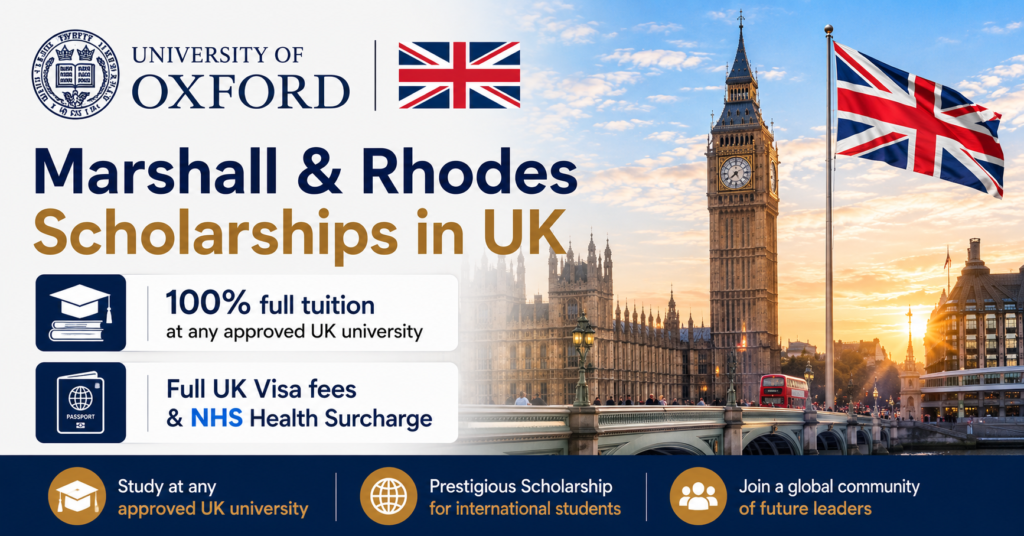
| Tuition Coverage | 100% full tuition at any approved UK university | 100% full tuition plus Oxford College fees |
| Living Stipend | £1,700 – £1,900 per month (location dependent) | £20,400 flat rate per year |
| Airfare & Flight Costs | Round-trip transatlantic economy flights | Round-trip international economy flights |
| Visa & Health Fees | Standard university entry support | Full UK Visa fees & NHS Health Surcharge |
| Research Grants | Cash allowances for books, thesis, & local travel | Academic support via Rhodes House networks |
Also check out: DAAD SECAI Scholarship 2026
Marshall & Rhodes Scholarships: Full Benefits and Financial Perks Breakdown
When evaluating the Marshall & Rhodes Scholarships, the financial rewards are unmatched in higher education. Both of these premier international fellowships eliminate the financial burdens of graduate school. They provide full funding packages that cover all institutional fees, travel expenses, and living costs.
Securing either award allows you to focus entirely on your academic research and leadership development without accumulating student debt.
Full Financial Benefits of the Marshall Scholarship
The Marshall Scholarship provides complete financial coverage to attend any accredited university within the United Kingdom. Whether you choose Oxford, Cambridge, the London School of Economics (LSE), or Edinburgh, the award covers your entire cost of attendance.
- Tuition and Fees: Covers 100% of university tuition, laboratory costs, and mandatory registration fees.
- Monthly Living Stipend: Provides a regular cash maintenance allowance—currently averaging £1,700 to £1,900 per month depending on your location—to manage your housing, food, and daily expenses.
- Transatlantic Flights: Pays for your initial economy flight from the United States to the United Kingdom, as well as your return flight home after graduation.
- Academic Allowances: Includes dedicated financial grants for textbook purchases, thesis preparation, and local travel required for your academic research.
Full Financial Benefits of the Rhodes Scholarship
The Rhodes Scholarship covers all essential costs specifically for postgraduate degree paths at the University of Oxford. The scholarship takes care of both university-wide expenses and individual Oxford college fees.
- Oxford University & College Fees: Pays all university tuition fees alongside your mandatory individual college membership dues.
- Annual Personal Stipend: Provides a direct living allowance of £20,400 per year to cover your accommodation and lifestyle costs within the city of Oxford.
- Visa & Health Insurance Coverage: Fully covers the cost of your UK Student Visa and pays the mandatory International Health Surcharge (IHS), granting you full access to the UK National Health Service (NHS).
- International Relocation Travel: Covers two economy-class flights—one to travel to Oxford at the start of your program and one to return home upon completion.
Also check out: KAAD Scholarship In Germany 2026-27
Top UK Universities Approved for Marshall & Rhodes Scholarships
1. Marshall Scholarship Approved Universities
- University of Cambridge
- London School of Economics and Political Science (LSE)
- University of Edinburgh
- Imperial College London
- King’s College London
- University of Manchester
- University of Oxford
- London School of Hygiene & Tropical Medicine (LSHTM)
- University of Bristol
- University of Glasgow
- University of Warwick
- University of Leeds
- University of Sheffield
- University of Nottingham
- University of St Andrews
- Royal College of Art
- Royal Academy of Music
2. Rhodes Scholarship Approved University
- University of Oxford (All constituent colleges including Balliol, Christ Church, Magdalen, New College, and St John’s)
Fields of Study Covered by the Marshall & Rhodes Scholarships
Both the Marshall & Rhodes Scholarships offer incredibly broad academic freedom. Instead of limiting candidates to a specific list of majors, they allow you to pursue almost any discipline at the postgraduate level. From cutting-edge STEM research to creative arts and global public policy, nearly every imaginable field is eligible.
To ensure your application clears eligibility checks, you must understand the wide spectrum of available categories alongside the critical, non-negotiable course restrictions enforced by each commission.
Broad Academic Disciplines Available
You can apply to complete a Taught Master’s (MSc, MA, MPhil) or a Doctoral Research Degree (PhD/DPhil) across the following master categories:
- STEM & Medicine: Theoretical Physics, Quantum Computing, Engineering, Aerospace, Organic Chemistry, Environmental Sciences, Climate Change Policy, Pure Mathematics, Data Science, Artificial Intelligence, and Biomedical Sciences.
- Social Sciences & Public Policy: International Relations, Global Governance, Economics, Anthropology, Sociology, Human Geography, Criminology, Public Policy, and Sustainable Development.
- Humanities & Creative Arts: World History, Philosophy, English Literature, Linguistics, Archaeology, Fine Art, Classical Music Performance, Creative Writing, and Theater Studies.
- Law & Legal Studies: International Human Rights Law, Criminology and Criminal Justice, Jurisprudence, and Environmental Law.
Critical Field Restrictions: What You Cannot Study
While the programs are highly flexible, certain fields are explicitly prohibited or heavily restricted due to funding caps, professional licensing rules, or course lengths. Listing a restricted program on your application will result in immediate disqualification.
1. Marshall Scholarship Specific Restrictions
The Marshall Commission does not fund degrees intended for commercial corporate training or multi-year professional medical licenses.
- Prohibited Business Degrees: Master of Business Administration (MBA) and MSc/MFE Financial Economics are not funded at any university.
- Prohibited Professional Licenses: Five-year professional clinical degrees in Medicine, Dentistry, Veterinary Science, and standard qualifying law degrees (LLBs) are excluded.
- Oxford Public Policy Cap: The Master of Public Policy (MPP) at the University of Oxford is capped—restricted to a maximum of one Marshall Scholar per academic year.
- Format Exclusions: Part-time courses, distance learning/online degrees, and short diplomas/certificates (PGCert/PGDip) are not allowed.
2. Rhodes Scholarship Specific Restrictions
The Rhodes Trust restricts courses that require outside employment or extend beyond standard timeline structures.
- Prohibited Clinical Paths: The four-year Accelerated Graduate-Entry course in Medicine is not tenable. Clinical Doctorates requiring direct employment inside the UK National Health Service (such as the DClinPsych) are completely banned.
- Executive & Part-Time Programs: Executive MBAs and part-time graduate degrees are strictly prohibited.
- Diploma Exclusions: PostGraduate Certificates (PGCert), PostGraduate Diplomas (PGDip), and the PostGraduate Certificate in Education (PGCE) are not funded. [7, 8]
Eligibility Criteria for Marshall & Rhodes Scholarships
To successfully advance past the initial screening rounds, applicants must meet specific age, citizenship, and academic benchmarks. Because the Marshall & Rhodes Scholarships are highly selective, meeting these minimum parameters is mandatory before your application can be evaluated on leadership merit.
Marshall Scholarship Eligibility Requirements
The Marshall Scholarship is designed specifically for high-achieving American citizens who want to pursue a graduate degree in the United Kingdom.
- Citizenship: You must be a citizen of the United States.
- Academic Standing: You must hold a minimum, non-negotiable undergraduate GPA of 3.70 on a 4.0 scale.
- Degree Window: You must graduate with your first bachelor’s degree from an accredited four-year US college or university between April 2024 and September 2027.
- Prior UK Study Restrictions: You are ineligible if you already hold a degree or a high-school level qualification from a British university or institution.
Rhodes Scholarship Eligibility Requirements
The Rhodes Scholarship selects young leaders from around the world to study at the University of Oxford. While the application is open globally, you must apply through your specific geographic constituency.
- Citizenship: You must be a citizen of one of the 60+ designated Rhodes constituencies (such as the US, Canada, India, Australia, or various African and European nations). If your country is not listed, you must apply through the Rhodes Global Scholarship pool.
- Academic Standing: You must complete your undergraduate bachelor’s degree by July 2027 with a GPA that demonstrates exceptional academic achievement (a 3.70+ GPA is typically expected to clear Oxford admissions).
- Age Limits (As of October 1, 2026):
- Standard Route: You must be at least 18 years old and have not passed your 24th birthday.
- Alternative Route: If you completed your undergraduate degree later than average, you may apply up to the age of 27, provided your first bachelor’s degree was awarded on or after October 1, 2025.
Required Documents for Marshall & Rhodes Scholarships Applications
To survive the rigorous initial screening process, you must submit a flawless dossier of official paperwork. Because the Marshall & Rhodes Scholarships require institutional clearance before you can submit to the central commissions, your documentation must be organized well in advance of national deadlines.
The essential checklists and required documents you need to gather for both programs include:
1. Marshall Scholarship Application Checklist
The Marshall application is submitted online and focuses heavily on your academic trajectory, connection to the UK, and long-term leadership goals.
- Official Academic Transcripts: A complete, certified record of your higher education coursework and cumulative GPA from all attended colleges or universities.
- The Personal Statement (Postgraduate Essay): A mandatory 750-word essay detailing your intellectual development, personal values, and how studying in the UK aligns with your career path.
- Proposed Academic Program Essay: A specific 500-word essay justifying your chosen UK universities and explaining your preferred degree courses.
- Leadership and Ambassadorial Statement: A 500-word essay demonstrating your potential to strengthen ties between the United States and the United Kingdom.
- Letters of Recommendation: Exactly four letters of reference. At least two must be from academic professors who can speak directly to your scholarly abilities.
- Institutional Letter of Endorsement: An official endorsement letter signed by your home university’s fellowship office or president.
2. Rhodes Scholarship Application Checklist
The Rhodes Scholarship application varies slightly depending on your home country or constituency, but the global core requirements remain highly consistent.
- Proof of Citizenship and Age: A certified copy of your birth certificate, valid international passport, or national identity document.
- Comprehensive Transcripts: Official undergraduate transcripts showing all completed coursework and your graduation status.
- The Rhodes Personal Statement: A strict, non-negotiable 750-word essay. This must be an authentic, unedited reflection of your character, interests, and motivations. Note: You must sign a pledge confirming no AI tools or advisors helped write this essay.
- List of Principal Activities (CV): A detailed curriculum vitae or resumé (capped at two pages) outlining your academic honors, athletic achievements, community service, and leadership roles.
- Letters of Recommendation: A minimum of five and a maximum of eight reference letters. At least three must be academic recommendations from professors who have taught you.
- Institutional Endorsement: A formal validation letter from your undergraduate university confirming you are an approved candidate for the current cycle.
Step-by-Step Guide: How to Apply for Marshall & Rhodes Scholarships
Applying for the Marshall & Rhodes Scholarships requires a multi-stage strategy that begins nearly a year before the actual national deadlines. Because you cannot apply directly to the central foundations without your university’s explicit permission, you must master a two-tier application process.
The step-by-step roadmap to successfully submit your application for the upcoming admissions cycle involves the following actions:
Phase 1: The Campus Endorsement Process (Spring to Summer)
Before competing nationally, you must win the backing of your home university. Most institutions only endorse a handful of candidates each year.
- Step 1: Contact Your Fellowship Office: Locate your university’s internal Office of Distinguished Fellowships. Notify them of your intent to apply by March or April.
- Step 2: Submit an Internal Application: Fill out your university’s preliminary application portal by their internal campus deadline (typically June or July). This includes draft essays and initial professor recommendations.
- Step 3: Clear the Campus Interview: Pass an in-person or virtual interview with a faculty committee. If selected, your university will issue an official Institutional Letter of Endorsement.
Phase 2: National Application Submission (August to October)
Once endorsed, you gain access to the official national portals to finalize your formal submission.
- Step 4: Complete the Online Portals:
- For the Marshall Scholarship, complete your profile on the official Marshall Application Portal.
- For the Rhodes Scholarship, register on the Rhodes Trust Application Platform.
- Step 5: Lock In Your References: Ensure your professors and mentors upload their final letters of recommendation directly into the secure portal before the absolute deadline.
- Step 6: Submit Before the Deadline: Hit submit before the strict late September or early October cutoff. Late applications are never accepted under any circumstances.
Phase 3: Regional Selection and Interviews (November)
The final hurdle involves high-stakes evaluation rounds conducted by the scholarship committees.
- Step 7: Await Finalist Notification: In mid-October, regional committees review all national applications and invite the top-tier candidates to interview.
- Step 8: Attend the Final Interview: Travel to your designated regional center (or log into a secure panel) for an intensive, 20-to-30-minute interview. Panels focus deeply on your essays, global current events, and ethical leadership scenarios.
- Step 9: Receive the Decision: Winners are announced publicly within 24 to 48 hours following the conclusion of the final regional interviews.
Apply to the Marshall track: Launch your application form directly via the Official Marshall Scholarship Portal.
Frequently Asked Questions (FAQ) About Marshall & Rhodes Scholarships
1. Can I apply for both the Marshall & Rhodes Scholarships at the same time?
Yes, you can absolutely apply for both programs simultaneously. If your goal is to pursue graduate-level studies at a world-class British institution like the University of Oxford, it is highly recommended to apply for both awards to maximize your funding chances. The application timelines align closely, but you must ensure your home university endorses your candidacy for both awards separately.
2. Do I need an admission offer from a UK university before applying?
No, you do not need an active university admission offer to apply for the scholarships. For both the Marshall & Rhodes Scholarships, you apply for the funding fellowship first. If you win the scholarship, the respective selection trusts will provide direct administrative support and financial clearance to help you secure your placement at your chosen British institution.
3. What is the minimum GPA requirement, and is it flexible?
The minimum required GPA is 3.70 on a 4.0 scale, and it is strictly non-negotiable. The Marshall Scholarship automated system will immediately disqualify applications falling below a 3.70 unrounded GPA. While the Rhodes Scholarship also enforces a 3.70 baseline, successful candidates across both Marshall & Rhodes Scholarships regularly present a competitive average of 3.90 or higher.
4. Can international students living in the US apply for the Marshall Scholarship?
No, the Marshall Scholarship is exclusively restricted to US citizens. Permanent residents (Green Card holders) and international students holding visas in the United States are not eligible to apply. International students must instead look toward the Rhodes Global Scholarship pool or other regional tracks.
5. Is there an age limit for these scholarships?
- Marshall Scholarship: There is no official age restriction. Instead, eligibility is determined by your undergraduate graduation date. You must apply within a few years of completing your first bachelor’s degree.
- Rhodes Scholarship: There are strict age boundaries. Standard applicants must be between 18 and 23 years old on October 1st of the application year. An extension up to age 27 is granted only if you completed your undergraduate degree later than average.
Disclaimer
The information provided in this guide regarding the Marshall & Rhodes Scholarships is for general informational and educational purposes only. While we strive to keep all details accurate, up-to-date, and optimized for applicant success, official scholarship regulations, stipend amounts, eligibility criteria, and application deadlines are subject to change at any time by the Marshall Aid Commemoration Commission and the Rhodes Trust.
- Official Sources: Applicants must always cross-reference specific program rules directly with the official Marshall Scholarship website and the official Rhodes Trust website.
- No Affiliation: This blog post is independent and is not officially endorsed by, affiliated with, or sponsored by the Marshall Commission, the Rhodes Trust, the University of Oxford, or any other mentioned UK university.
- No Guarantee of Success: Utilizing the strategic advice, checklists, or steps outlined in this article does not guarantee campus endorsement, an invitation to regional interviews, or selection as a scholarship recipient.