The University of Florence (Università degli Studi di Firenze – UNIFI), established in 1321, stands as one of the oldest, most prestigious, and highly ranked public research institutions in Europe.
For the 2026/2027 academic year, the Italian Government, in collaboration with DSU Toscana and UNIFI, is opening its doors to international students worldwide. This fully funded initiative targets exceptional minds across Bachelor’s, Master’s, and PhD pathways, completely eliminating the burden of tuition costs and European living expenses.
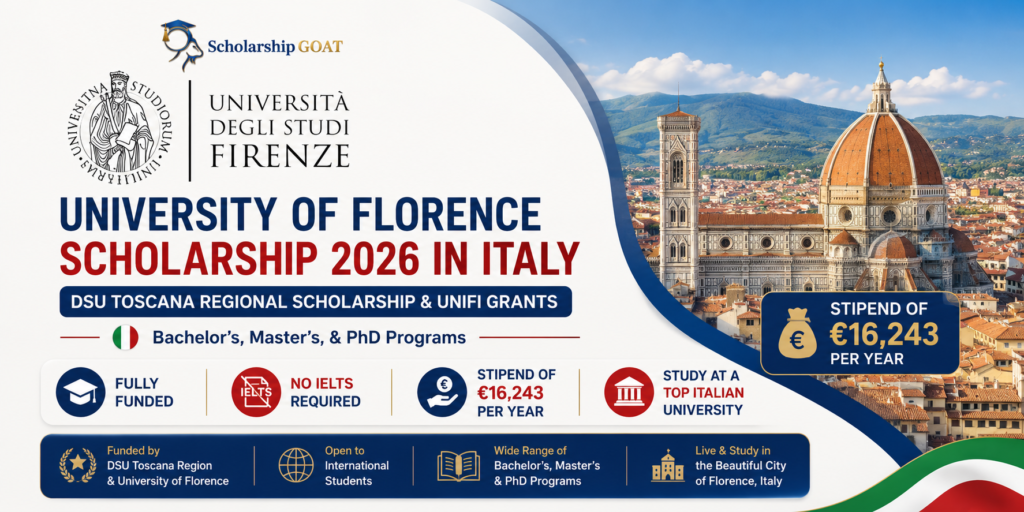
📊 Summary Table of University of Florence Scholarship
The matrix below outlines the baseline administrative, logistical, and structural components governing the University of Florence Scholarship fully funded scholarship cycle for the 2026/2027 academic calendar.
| Administrative Parameter | Official Institutional / Regional Data Specification |
|---|---|
| Host Country Location | Florence, Tuscany, Italy 🇮🇹 |
| Host Academic Institution | University of Florence (Università degli Studi di Firenze – UNIFI) |
| Primary Funding Bodies | DSU Toscana Regional Government & UNIFI Institutional Endowment |
| Eligible Degree Levels | Undergraduate (Bachelor’s), Postgraduate (Master’s), Doctoral (PhD) |
| Financial Status Indicator | Fully Funded Program (Zero Tuition + Cash Stipends + Free Boarding) |
| Maximum Annual Stipend | Up to €8,000 net cash per year (Distributed across annual installments) |
| Language Exemption Route | Fully Valid (English Medium of Instruction Certificate replaces IELTS/TOEFL) |
| University Portal Fee | €20 evaluation processing charge for standard program admission |
| Academic Calendar Start | September / October 2026 |
| PhD Application Deadline | June 11, 2026 at 12:00 PM Italian Time |
| Master’s Late Admission Window | June 15 – August 31, 2026 |
| DSU Regional Funding Deadline | Early September 2026 (Tentative based on system portal releases) |
| Official Application Mode | Dual Portal Electronic Submission (UNIFI Admission + DSU Funding Portals) |
Also check out: Romanian Govt ARICE Scholarship 2026
🎁 Comprehensive Scholarship Benefits
The financial support structure at the University of Florence Scholarship is designed to completely eliminate the expenses associated with relocating to and living in Western Europe. Rather than offering a simple discount on tuition, the combined framework of the UNIFI Institutional Grants and the DSU Toscana Regional Scheme addresses every financial challenge an international student might face.
The funding is structured to provide complete peace of mind, ensuring that students can focus entirely on their academic performance and research projects without needing to find part-time work. The comprehensive benefits package includes the following provisions:
1. 100% Tuition Fee Waivers and Enrollment Exemptions
Students who receive this award are completely exempt from paying the university’s annual tuition fees, which can otherwise reach up to €3,000 per year for non-EU international students. This benefit covers the entire duration of your degree program, provided you maintain basic academic progress. Additionally, the regional student welfare tax (Tassa Regionale per il Diritto allo Studio Universitario) and standard administrative registration costs are fully waived, reducing your mandatory university fees to zero.
2. Annual Cash Stipend
The University of Florence Scholarship provides a direct cash stipend designed to cover personal expenses, books, healthcare insurance, and local transport.
- Stipend Value: The cash amount ranges from €7,000 to €8,000 per academic year, depending on the student’s legal residential status (“Fuori Sede” or out-of-town/international student category).
- Payment Schedule: This stipend is split and paid out in two or three structured installments across the academic year, transferred directly into the student’s Italian bank account.
- PhD Bonus: Students admitted to fully funded PhD tracks receive an increased gross baseline stipend of €16,243 per year, which is boosted by an extra 50% for any approved research periods spent abroad.
3. Free University Accommodation
Finding affordable housing in Florence can be highly competitive and expensive for international students. This scholarship directly addresses that challenge.
- Priority Housing: Awarded students receive priority, free placement in the official residential dormitories managed by DSU Toscana.
- Room Standards: These accommodations feature fully furnished single or double rooms, high-speed internet access, study lounges, laundry facilities, and shared or private kitchenettes.
- Rent Allowance Alternative: If the university dormitories reach maximum capacity, the funding shifts to provide a dedicated monthly rent allowance to help cover the cost of a private apartment in the city.
4. Daily Complimentary Campus Meal Plan
To ensure students have access to nutritious food throughout their studies, the program includes a robust, subsidized meal plan.
- Free Daily Meals: Students are entitled to free, fully balanced meals every day at the official university student canteens (Mense Universitarie) spread across Florence’s campuses.
- Flexible Options: The meal vouchers cover a complete Italian lunch or dinner, including a first course, second course, side dishes, desserts, and beverages, with options available for vegetarian, vegan, and halal dietary requirements.
5. Need-Based Selection (The ISEE Parificato System)
Unlike traditional academic scholarships that only reward students with perfect grades, this funding model prioritizes equal opportunity.
- Financial Assessment: Selection is heavily based on your family’s financial background, measured using an economic index called the ISEE Parificato.
- Fair Evaluation: This system ensures that brilliant students from developing economies or modest financial backgrounds receive the same funding opportunities as those with perfect GPAs, making it one of the most accessible and fair scholarship systems in Europe.
📚 Eligible Study Fields under University of Florence Scholarship
The University of Florence offers an extensive selection of degree programs taught in English and Italian across its 10 main schools. To help you match your background with the right choice, the complete list of available majors is organized by academic department below.
You can apply for the scholarship while pursuing any of these qualifications, provided the program is officially registered for the 2026/2027 academic year.
1. Engineering, Technology, and Computer Sciences
- Artificial Intelligence: Advanced computing, deep learning systems, machine learning models, and cognitive computing.
- Computer Engineering: Software architecture, hardware-software integration, system design, and cyber-physical infrastructure.
- Data Science: Statistical modeling, big data analytics, predictive computing, and business intelligence.
- Geoengineering: Rock mechanics, tunnel design, landslide prevention, and advanced structural environmental protection.
- Civil Engineering: Structural analysis, infrastructure systems, transportation design, and urban hydraulic systems.
- Mechanical Engineering: Thermodynamic systems, advanced materials, industrial machine manufacturing, and robotics.
- Management Engineering: Supply chain logistics, industrial production systems, operations management, and corporate strategy.
- Environmental Engineering: Waste management, water treatment plants, climate risk mitigation, and ecosystem restoration.
- Electronic Systems Engineering: Microelectronics, signal processing, embedded systems design, and telecommunications networks.
- Software Engineering: Software lifecycle development, cloud infrastructure, app deployment, and distributed ledger systems.
2. Economics, Finance, and Business Management
- Economics: Macroeconomic analysis, microeconomic markets, econometric modeling, and public policy evaluation.
- Finance and Risk Management: Quantitative finance, corporate risk evaluation, investment banking, and derivatives.
- Economics and Development: Global trade policy, poverty alleviation strategies, institutional growth, and regional planning.
- International Business and Development: Multinational corporate strategy, cross-border trade law, and global market expansion.
- Accounting and Financial Control: Corporate auditing, taxation management, managerial accounting, and corporate governance.
- Marketing and International Management: Consumer behavior, brand asset management, digital marketing, and global supply management.
- Human Development and Food Security: Sustainable agricultural policies, food supply chain protection, and global nutrition advocacy.
3. Natural, Chemical, and Physical Sciences
- Chemical Sciences: Analytical chemistry, physical molecular models, organic synthesis, and advanced materials chemistry.
- Physics and Astronomy: Astrophysics, quantum mechanics, subatomic physics, condensed matter, and space exploration tech.
- Mathematics: Pure mathematical analysis, applied geometry, computational mathematics, and stochastic logic systems.
- Computer Science: Theoretical computation, cryptographic security, algorithm complexity, and systems network infrastructure.
- Advanced Molecular Sciences: Nanotechnology, macromolecular structure, structural biology, and chemical biology.
4. Health, Life, and Agricultural Sciences
- Health Science: Public health strategies, epidemiology, healthcare management, and community health protection.
- Biotechnology: Industrial bioprocesses, genetic manipulation, agricultural biotechnology, and microbial systems.
- Medical and Pharmaceutical Biotechnology: Vaccine development, molecular pharmacology, gene therapy, and diagnostic tools.
- Nursing and Midwifery: Clinical nursing practice, maternal healthcare systems, pediatric care, and emergency nursing.
- Pharmacy: Industrial drug design, clinical pharmacy operations, toxicology, and pharmaceutical pharmacology.
- Human Nutrition Sciences: Metabolic dietetics, clinical nutrition plans, food safety tracking, and public health nutrition.
- Medical Sciences: Clinical medicine research, pathology, advanced internal medicine, and surgical principles.
- Dental Medicine: Orthodontics, periodontics, oral surgery, prosthodontics, and comprehensive dental health care.
- Agricultural Sciences: Smart farming practices, soil fertility management, crop cultivation, and agricultural economics.
- Food Science and Technology: Food preservation methods, quality control testing, food safety audits, and product formulation.
- Viticulture and Enology: Vine physiology, wine production techniques, winery operations, and sensory evaluation methods.
5. Humanities, Languages, and Arts
- History and Archaeology: Ancient civilizations, excavation techniques, archival research, and medieval Mediterranean studies.
- Geography and Environmental Studies: Geographic Information Systems (GIS), human cartography, and climate change patterns.
- Philosophy: Epistemology, ethical theory, political philosophy, logic, and the history of continental thought.
- Languages and Literatures: Comparative literature, translation studies, European text analysis, and global literary traditions.
- Linguistics: Phonetics, syntactic analysis, historical linguistics, psycholinguistics, and computational language processing.
- Art History: Renaissance masterpieces, medieval iconography, contemporary curatorial practices, and art preservation theory.
- Performing Arts and Media: Theatre history, cinematic analysis, digital media communication, and cultural event production.
- Cultural Heritage Studies: Museology, heritage preservation law, archival conservation, and cultural tourism management.
6. Social Sciences, Law, and Architecture
- Psychological Sciences: Cognitive psychology, social behavioral dynamics, developmental psychology, and research methods.
- Political Science: Comparative politics, governance frameworks, public administration, and political theory.
- International Relations: Geopolitical strategy, international diplomacy, global security, and conflict resolution models.
- Sociology and Social Research: Social inequality, urban sociology, research statistics, and qualitative social modeling.
- Law and Legal Studies: Constitutional law, international criminal law, European union jurisprudence, and corporate law.
- European Studies: European integration history, EU institutional policymaking, and continental economic frameworks.
- Architecture: Architectural design, structural preservation, sustainable building materials, and history of structures.
- Sustainable Architecture: Energy-efficient building design, green building certifications, renewable energy integration, and eco-materials.
- Urban Planning: Smart city infrastructure, spatial zoning, public transport design, and urban landscape architecture.
- Education Sciences: Pedagogical theories, curriculum development, instructional technology, and inclusive learning models.
🎓 Eligibility Criteria for University of Florence Scholarship
To secure both academic admission to the University of Florence Scholarship and the accompanying fully funded DSU Toscana Regional Scholarship, applicants must satisfy a dual layer of requirements. You must first meet the university’s academic entry conditions and then pass the regional financial background checks.
The complete eligibility criteria for the 2026/2027 academic intake are detailed below:
1. Nationality and Regional Origin
- Open to All Nationalities: The program is open to Italian citizens, EU nationals, and non-EU international citizens residing outside of Italy.
- No Discrimination Based on Country: Applicants from developing nations, emerging markets, and high-income countries are equally welcome to apply.
- Special Context: Students from designated Least Developed Countries (LDCs) receive simplified verification pathways for their family financial documentation.
2. Academic Entry and Level Requirements
- For Bachelor’s Degree Programs: Applicants must hold a valid high school diploma or secondary school leaving certificate representing at least 12 years of continuous education.
- For Master’s Degree Programs: Candidates must hold an accredited Bachelor’s degree (or equivalent foreign undergraduate diploma) in a field closely related to the targeted Master’s course.
- For PhD Programs: Applicants must hold a valid Master’s degree or an equivalent second-cycle higher education qualification.
- Grade Point Average (GPA): While the scholarship itself is need-based, the university’s admission committees generally look for a minimum equivalent GPA of 2.6 out of 4.0 (or your local equivalent) to approve your initial academic entry.
3. Language Proficiency Rules (No-IELTS Pathway)
- English-Taught Programs: If you select a program where the medium of instruction is English, you must show proof of language proficiency.
- The No-IELTS Exemption: You do not need an IELTS or TOEFL certificate if your previous degree was completed entirely at an institution where English was the medium of instruction. To claim this exemption, you must provide an official English Medium of Instruction (MOI) Certificate issued by your previous school or university registrar.
- Standard Language Tests: If your previous education was not conducted in English, you can instead provide a standard language certificate, such as an IELTS (Minimum overall score of 6.0) or a TOEFL iBT (Minimum score of 80).
- Italian-Taught Programs: For degrees conducted in Italian, applicants must provide an official B2-level Italian proficiency certificate (such as CILS or CELI).
4. Financial Eligibility Thresholds (The ISEE Parificato Score)
The regional DSU Toscana scholarship is designed to support students who genuinely need financial aid. Your eligibility is determined by your household’s financial standing.
- What is ISEE Parificato?: This is an official economic indicator used by Italian authorities to assess the income and assets of international students’ families.
- The Income Cap: To qualify for the full scholarship package (free tuition, free housing, free meals, and the maximum cash stipend), your family’s annual ISEE Parificato score must fall below €25,000–€27,000 (the precise limit is adjusted slightly each summer by the Tuscan regional government).
- Asset Assessment: The calculation takes into account your parents’ annual gross salaries, any business income, bank balances as of December 31, and any real estate or property owned by the household.
📝 Required Documents for University of Florence Scholarship
To successfully apply for admission and secure the fully funded scholarship at the University of Florence, you must prepare two distinct sets of documents. The first set is evaluated by the university admission committee for academic suitability, while the second set is used by the Italian regional authorities to assess your financial eligibility.
All documents must be clear, legible, and provided in PDF format. Documents not originally in English or Italian must be officially translated.
1. Academic and Personal Documents (For UNIFI University Admission)
- Valid International Passport: A clear scan of the primary biometric page showing your photo, full legal name, date of birth, and passport validity. Your passport must be valid beyond your planned date of entry into Italy.
- Academic Degrees and Diplomas: Your official high school diploma (for Bachelor’s applicants), undergraduate degree certificate (for Master’s applicants), or postgraduate degree certificate (for PhD applicants).
- Official Academic Transcripts: A comprehensive record of all subjects studied, grades received, and credits earned during your previous degree.
- Curriculum Vitae (CV): An updated professional resume outlining your academic history, work experience, research projects, skills, and publications. Using the official Europass CV format is highly recommended for European universities.
- Statement of Purpose (SOP) / Motivation Letter: A well-crafted essay (typically 1–2 pages) explaining why you chose the University of Florence, your interest in the specific field of study, your career goals, and why you deserve to be selected.
- Letters of Recommendation (LOR): One or two reference letters written and signed by your previous university professors, lecturers, or academic advisors who can vouch for your academic capabilities.
- Proof of Language Proficiency: An official English Medium of Instruction (MOI) Certificate from your previous institution’s registrar confirming your prior degree was taught entirely in English. If you do not have this, you must upload an official IELTS or TOEFL scorecard instead.
2. Legal and Financial Welfare Documents (For the DSU Toscana Scholarship)
To calculate your mandatory ISEE Parificato score, you must compile specific financial records reflecting the economic status of your family home for the previous calendar year.
- Family Composition Certificate: An official government document detailing all members of your household, listing names, dates of birth, and their legal relationship to you (parents, siblings, etc.).
- Gross Annual Household Income Certificate: Official documents showing the total annual income earned by every working member of your household. This can include income tax returns, salary slips, employer statements, or pension records.
- Real Estate and Property Records: A document certifying whether your family owns or rents their primary residence. If owned, the document must state the total built-up area in square metres. If rented, a copy of the official lease agreement showing the annual rent paid must be provided. If your family does not own property, a certificate of non-ownership or housing status must be submitted.
- Bank Balances and Liquid Assets: Official bank statements showing the closing balances of all bank accounts held by every member of your family as of 31 December of the preceding calendar year, along with records of any stocks, bonds, or shared family business assets.
3. Strict Rules for Financial Document Legalisation
To prevent fraud and ensure your financial documents are legally recognized by the Italian government, they must go through a formal verification process based on your home country’s legal agreements with Italy:
- For Apostille Countries: If your country is a member of the Hague Convention, all your original local financial documents must receive an official Apostille stamp from your country’s Ministry of Foreign Affairs before being translated.
- For Non-Apostille Countries: If your country does not use the Apostille system, your documents must be legalized by your local Ministry of Foreign Affairs and then verified and stamped by the Embassy or Consulate of Italy located in your home country.
- Translation Requirement: Once legalised, these documents must be fully translated into Italian by an official, sworn translator or a translation service approved by the Italian Embassy.
🚀 How to Apply
The application process for the University of Florence Scholarship fully funded framework requires navigating two separate online portals. You cannot apply for the regional scholarship without first securing academic placement from the university. Follow this step-by-step roadmap to complete your application for the 2026/2027 academic intake.
Step 1: Apply for Admission ➔ Step 2: Pay the €20 Fee ➔ Step 3: Get Your Admission Letter ➔ Step 4: Obtain ISEE Parificato ➔ Step 5: Submit DSU Funding Form
Step 1: Submit Your Academic Application to UNIFI
- Visit the official online application portal of the University of Florence.
- Create an account, verify your email address, and select your preferred degree program from the available courses.
- Fill out the application form with your personal details, academic history, and contact information.
- Upload all required academic documents, including your transcripts, degree certificates, CV, Statement of Purpose, and your English Medium of Instruction (MOI) Certificate (or IELTS scorecard).
Step 2: Pay the University Processing Fee
- Once your application form is complete, proceed to the payment section within the portal.
- Pay the non-refundable university evaluation fee of €20 using a credit card or an approved international payment method.
- Submit your completed application profile before the closing date of your chosen intake window.
Step 3: Receive Your Official Admission Offer
- The academic committee of the relevant department will review your qualifications, grades, and motivational statement.
- If you meet the academic requirements, the university will issue an official pre-admission offer letter via email or the portal.
- Download this document and keep it safe, as it is a mandatory requirement for both your visa application and your regional scholarship request.
Step 4: Obtain Your ISEE Parificato Economic Score
- Contact an approved CAF office (Centro di Assistenza Fiscale) in Italy. Many of these offices allow international students to submit their documents online through dedicated digital portals or email.
- Submit your translated and legalized family financial documents, including income statements, bank balances, property records, and your family composition certificate.
- The CAF office will process your data free of charge and generate your official ISEE Parificato Certificate, which states your family’s exact financial index score.
Step 5: Apply on the DSU Toscana Scholarship Portal
- Once the regional funding portal opens for the 2026/2027 cycle, navigate to the official DSU Toscana website.
- Create a student profile on the portal and select the University of Florence as your host institution.
- Fill out the welfare application form and upload your official UNIFI admission letter alongside your freshly generated ISEE Parificato Certificate.
- Review your entries carefully and submit the digital scholarship form before the early September deadline.
The provisional ranking lists are typically published in late September or early October, detailing whether you have been designated as a winner (Vincitore) or an eligible non-winner (Idoneo non Vincitore) based on regional fund availability.
❓ Frequently Asked Questions (FAQ) about University of Florence Scholarship
To help you navigate the process smoothly, here are the answers to the most common questions international students ask when applying for the University of Florence and the DSU Toscana Scholarship:
1. Can I apply for this scholarship if I don’t have an IELTS or TOEFL certificate?
Yes, absolutely. The University of Florence Scholarship allows an alternative language pathway. If your previous degree (high school diploma or Bachelor’s degree) was taught entirely in English, you can submit an official English Medium of Instruction (MOI) Certificate issued by your previous school or university registrar. This document completely replaces the need for IELTS or TOEFL.
2. Is this scholarship based on high academic grades or financial need?
The DSU Toscana Regional Scholarship is primarily a need-based financial aid program, not a merit-based one. Selection is determined by your family’s financial situation, calculated through your ISEE Parificato score. As long as you meet the university’s basic academic entry requirements and secure an admission letter, your grades will not affect your ranking for the scholarship.
3. What happens if my ISEE Parificato score is higher than the €25,000 threshold?
If your calculated family economic index score exceeds the regional threshold, you will not qualify for the full scholarship benefits (such as the maximum cash stipend and free accommodation). However, you may still be eligible for a partial tuition fee waiver or reduced university tax rates based on your specific income bracket.
4. Can I apply for the DSU Toscana scholarship before getting my university admission letter?
No, you cannot. The DSU scholarship portal requires you to upload proof of registration or a valid pre-admission offer letter from the University of Florence. You must secure your place at the university during the open academic intake windows before you can apply for regional funding.
5. Are the university dormitories guaranteed for all scholarship winners?
Scholarship winners (vincitori) receive priority access to free university housing. However, because spaces in the official DSU dormitories in Florence are limited, some eligible students may initially be placed on a waiting list. If the university cannot provide a physical room, they will typically replace the free housing benefit with a monthly rent allowance to help you secure private accommodation in the city.
6. Do I need to pay back the annual cash stipend after I graduate?
No, this is a fully funded grant, not a student loan. You do not need to pay back any of the cash stipends, tuition waivers, or meal allowances. However, to keep the scholarship for the following academic year, you must successfully pass a minimum number of credits (CFU) required by your specific degree program.
⚠️ Disclaimer
The information provided on this page regarding the University of Florence (UNIFI) admissions, the DSU Toscana Regional Scholarship, and associated Italian Government funding schemes for the 2026/2027 academic year is compiled for general educational and informational purposes only.
ScholarshipGOAT is an independent educational media platform. We are not an official partner, representative, or affiliate of the University of Florence, the Azienda Regionale per il Diritto allo Studio Universitario (DSU Toscana), or the Italian Ministry of University and Research (MUR). We do not guarantee the accuracy, completeness, or real-time updates of institutional requirements, currency values, financial thresholds, or calendar deadlines.
Funding policies, regional budget allocations, documentation legalization laws, and university admission guidelines are subject to change without notice by the respective institutional and government authorities in Italy. All applicants are strictly advised to consult the official web portals of the University of Florence and DSU Toscana to verify all procedural steps, forms, and administrative criteria before submitting financial paperwork or paying processing fees.