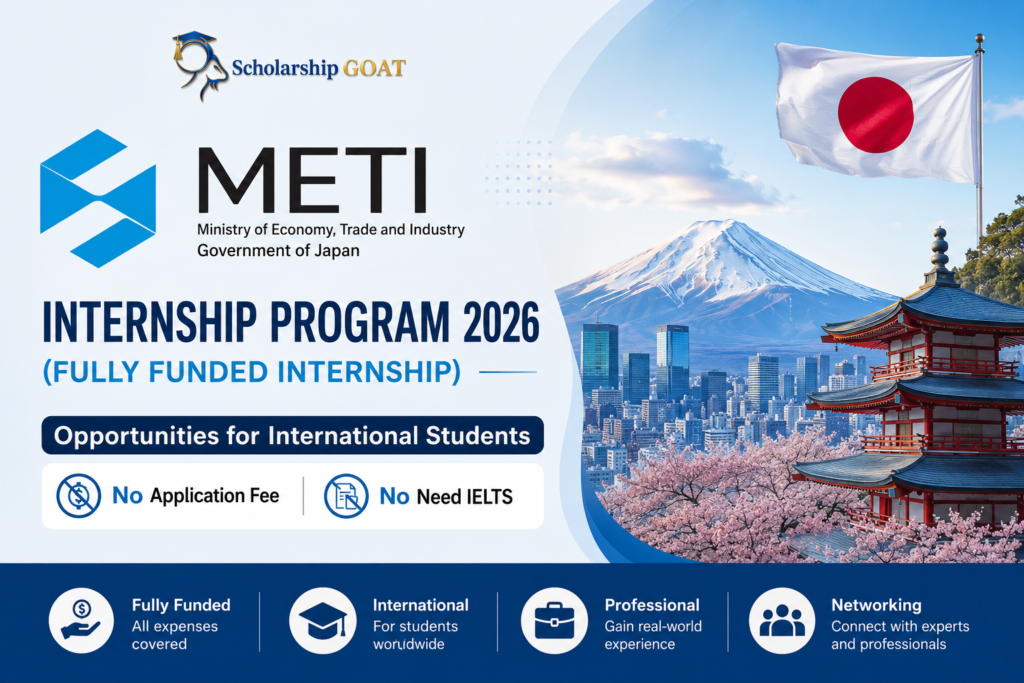
The METI Government of Japan Internship Program 2026 is a prestigious initiative funded by the Ministry of Economy, Trade and Industry of Japan. It aims to bridge international talent with Japanese small and medium-sized enterprises to foster global business innovation. This program provides a unique opportunity for young professionals and students to gain hands-on experience, learn Japanese business culture, and establish a professional network in Japan without any application fees.
Program Summary
| Feature | Details |
|---|---|
| Host Country | Japan |
| Sponsor | Ministry of Economy, Trade and Industry (METI) |
| Application Fee | Free ($0) |
| Financial Coverage | Fully Funded |
| Internship Type | In-person or Hybrid |
| Target Audience | Students and Young Professionals |
Program Benefits
The METI Government of Japan Internship Program provides comprehensive financial and professional support tailored to the track you choose:
- Daily Allowance: In-person interns receive ¥3,000 per day, while online interns receive ¥1,000 per day.
- Travel Expenses: Full coverage of round-trip economy class airfare to Japan for the in-person course.
- Free Accommodation: Fully arranged housing, including covered utilities and living equipment during the placement.
- Visa & Insurance: Complete visa application assistance and fully paid travel and internship insurance.
- Language Training: Access to intensive Japanese language training courses before and after the internship.
- Tech Resources: Free rental of a mobile phone, laptop, and pocket Wi-Fi as needed for tasks.
Eligible Study Fields
This program welcomes applicants from all academic backgrounds. However, the most highly sought-after fields include:
- Engineering & Technology (Computer Science, Mechanical, Civil, Electrical, AI, Data Science)
- Business & Economics (International Business, Marketing, Finance, Management, MBA)
- Natural Sciences (Physics, Chemistry, Biotechnology, Environmental Science)
- Social Sciences & Humanities (International Relations, Communications, Media, Design)
Eligible Countries
Citizens of developing countries listed on the OECD/DAC List of ODA Recipients (excluding China) are eligible to apply. The METI Government of Japan Internship program includes the following countries:
- ASEAN & South Asia: Afghanistan, Bangladesh, Bhutan, Cambodia, India, Indonesia, Iran, Laos, Malaysia, Maldives, Mongolia, Myanmar, Nepal, Pakistan, Philippines, Sri Lanka, Thailand, Timor-Leste, Uzbekistan, Vietnam.
- Africa: Algeria, Angola, Benin, Botswana, Burkina Faso, Burundi, Cabo Verde, Cameroon, Central African Republic, Chad, Comoros, Democratic Republic of the Congo, Republic of the Congo, Côte d’Ivoire, Djibouti, Egypt, Equatorial Guinea, Eritrea, Eswatini, Ethiopia, Gabon, Gambia, Ghana, Guinea, Guinea-Bissau, Kenya, Lesotho, Liberia, Libya, Madagascar, Malawi, Mali, Mauritania, Mauritius, Morocco, Mozambique, Namibia, Niger, Nigeria, Rwanda, São Tomé and Príncipe, Senegal, Sierra Leone, Somalia, South Africa, South Sudan, Sudan, Tanzania, Togo, Tunisia, Uganda, Zambia, Zimbabwe.
- Latin America: Argentina, Belize, Bolivia, Brazil, Colombia, Costa Rica, Cuba, Dominica, Dominican Republic, Ecuador, El Salvador, Grenada, Guatemala, Guyana, Haiti, Honduras, Jamaica, Mexico, Montserrat, Nicaragua, Paraguay, Peru, Saint Lucia, Saint Vincent and the Grenadines, Suriname, Venezuela.
- Eastern Europe & Central Asia: Albania, Armenia, Azerbaijan, Belarus, Bosnia and Herzegovina, Georgia, Iraq, Jordan, Kazakhstan, Kosovo, Kyrgyzstan, Lebanon, Moldova, Montenegro, North Macedonia, Palestinian Territories, Serbia, Syria, Tajikistan, Turkey, Turkmenistan, Ukraine, Yemen.
- Oceania: Fiji, Kiribati, Marshall Islands, Micronesia, Nauru, Niue, Papua New Guinea, Samoa, Solomon Islands, Tokelau, Tonga, Tuvalu, Vanuatu, Wallis and Futuna.
Core Eligibility Requirements
To be eligible for the METI Government of Japan Internship Program 2026, you must fulfill all of the following administrative and academic conditions:
- Age Limit: Candidates must be between 18 and 39 years old as of August 24, 2026.
- Academic Status: You must be currently enrolled in your final year of university (undergraduate or graduate) or already be a university graduate.
- Language Proficiency: You must possess a strong, verifiable command of either English or Japanese (JLPT N3 level or higher is preferred but not strictly required).
- Program Objective Alignment: You must express a genuine intent to learn Japanese business practices and contribute to the global expansion of local businesses.
- Prior Participation Restriction: You cannot apply if you have participated in this specific METI internship program at any point between FY2016 and FY2025.
- Location Requirements: You must currently reside outside of Japan at the exact time you submit your application.
Required Documents
To complete your profile on the METI Japan Internship Program portal, prepare clear, digital scans of the following paperwork:
- Identity & Citizenship: A clear copy of your valid international passport.
- Academic Verification: University certificate of graduation (for graduates) or official certificate of enrollment (for current students).
- Recommendation Letter: One formal endorsement letter from a university professor, faculty member, or current employer.
- Language Proficiency Proof: Valid test certificates validating your English or Japanese language skills (such as IELTS, TOEFL, or JLPT N3+) if applicable.
- Curriculum Vitae (CV): An updated resume highlighting your skills, research area, and relevant projects.
- Statement of Purpose (SOP): A written essay describing your career targets and motivation for joining a Japanese SME.
- Recent Photograph: One passport-size identification photo.
How to Apply Step-by-Step Guide
Follow this walkthrough to submit your application on the official METI Japan Internship Portal:
- Step 1: Provisional Registration
Go to the foreign nationals section on the official portal, enter your email address, and submit the initial form to provisionally register. - Step 2: Access the Application Link
Check your email inbox for a custom, private registration link sent by the program office within a few minutes. - Step 3: Complete Personal & Academic Profiles
Click the custom link, set the form language, and fill out your personal details, language proficiencies, and university enrollment details. - Step 4: Enter Specialized Skills & Work History
Detail your research focus, technical skills, and any past professional experience that matches the requirements of Japanese small and medium-sized enterprises. - Step 5: Upload Required Documents
Attach clear scans of your passport, current resume/CV, graduation or enrollment certificate, and a formal recommendation letter. - Step 6: Review and Submit
Double-check all fields for absolute accuracy against your official identification, click the final submit button, and save your application confirmation number.
Verified official links for the internship program:
- Official Website: Access the main landing page and program information via the METI Japan Internship Program Official Website.
- Application Portal: Review full guidelines and access the entry registration system via the METI Japan Internship Program Application Portal.
METI Internship Interview: Questions
Here is the complete list of 10 essential interview questions paired with high-scoring answers to help you prepare:
Question 1: “Why do you want to intern in Japan, and specifically through the METI program?”
- Answer: “I want to intern in Japan because of its global reputation for blending cutting-edge technological innovation with structured, efficient corporate practices. Specifically, the METI program stands out to me because it pairs international talent directly with local small and medium-sized enterprises. These businesses are agile and offer hands-on environments where my work can make an immediate, measurable impact. I want to contribute my perspective to help a Japanese business expand its global reach while learning their core principles of operations first-hand.”
Question 2: “How do you plan to handle the cultural and language barriers you might face during your placement?”
- Answer: “I view cultural differences as learning opportunities rather than barriers. To prepare, I am already studying basic conversational Japanese and essential business etiquette, such as proper greetings and team dynamics. In the workplace, I plan to handle communication gaps by actively listening, taking detailed notes, and confirming my understanding using simple language or visual aids. I am highly adaptable and will rely on patience, observation, and respect for the local workplace culture to build smooth, professional relationships.”
Question 3: “What specific skills or academic knowledge can you bring to a Japanese small or medium-sized enterprise (SME)?”
- Answer: “I bring a strong foundation in data analysis and digital marketing, along with a deep understanding of consumer behavior in South Asian markets. During a recent university project, I built a predictive model that optimized local market outreach, which improved target engagement by 15%. I can apply these exact analytical and localization skills to help a Japanese SME identify new growth channels, refine its digital presence, and bridge the cultural gap when looking to expand into international markets.”
Question 4: “How will this internship experience influence your long-term career goals?”
- Answer: “My long-term career goal is to become an international project manager who facilitates business trade and technical collaboration between Japan and my home country. This internship will give me the practical cross-cultural experience, corporate network, and foundational Japanese business knowledge necessary to step into that role. By understanding how Japanese businesses operate from the inside out, I can serve as an effective, long-term bridge-builder between our economies.”
Question 5: “Can you give an example of a difficult challenge you faced and how you overcame it?”
- Answer: “During a major group project at university, two core team members dropped out unexpectedly, leaving us with double the workload just a week before the deadline. I stepped up to reorganize our remaining team, broke down the remaining technical tasks into clear daily goals, and handled the data visualization phase myself. By managing our time strictly and communicating openly, we submitted the project on schedule and earned an A grade. This taught me how to stay calm and lead efficiently under sudden pressure.”
Question 6: “Japanese companies heavily emphasize teamwork and group harmony (Wa). How do you fit into this style?”
- Answer: “I highly value collaborative workspaces and always prioritize active listening over pushing my own ideas first. In my previous academic projects, I made it a point to check in with my teammates regularly, ensure everyone’s input was heard, and offer help whenever someone fell behind. I understand that individual success in a Japanese company comes from the collective success of the group, and I am excited to contribute positively to maintaining that workplace harmony.”
Question 7: “What specific goals do you hope to achieve during your first two weeks at the host company?”
- Answer: “My primary goal for the first two weeks is to fully adapt to the company’s daily workflow, understand their specific communication channels, and build rapport with my mentor and colleagues. I plan to take thorough notes during onboarding, ask targeted questions to avoid mistakes, and familiarize myself with the business’s current projects. By setting a strong foundation early on, I can start delivering meaningful, error-free support to the team as quickly as possible.”
Question 8: “How do you handle receiving critical feedback from a manager or supervisor?”
- Answer: “I welcome critical feedback because it is the fastest way to grow professionally. If a manager points out a mistake in my work, I listen objectively without getting defensive, thank them for their guidance, and clarify the exact steps needed to correct it. In my past roles, I have always documented feedback so that I could review it later and ensure that the same error was never repeated twice.”
Question 9: “Are you open to working for a Japanese company long-term after graduation?”
- Answer: “Yes, I am highly open to that opportunity. I believe that launching a long-term career within a Japanese corporate environment would allow me to master highly disciplined project management methodologies and quality control standards. If my skills align well with the host company’s long-term global expansion goals during this internship, I would be thrilled to discuss future career opportunities with them.”
Question 10: “What will you do if you are assigned a task that you do not know how to complete?”
- Answer: “If I face an unfamiliar task, I will first spend 15 to 20 minutes researching solutions independently using available company documentation or reliable resources. If I still need guidance, I will approach my mentor with a clear explanation of what I have tried so far and present specific questions. This shows that I am resourceful and respect my team’s time while ensuring that I complete the task accurately according to company standards.”
Disclaimer
- Disclaimer: This post is for informational purposes only. Scholarship GOAT is not an official partner, representative, or agent of the Ministry of Economy, Trade and Industry (METI) of Japan. While we strive to keep all details accurate and up to date, program guidelines, deadlines, and eligibility criteria can change at any time without notice. Applicants are strongly advised to verify all details and submit their final applications directly through the official METI Japan Internship Program Website.
Frequently Asked Questions (FAQ)
Here are the most common questions your followers might ask about the METI program:
- Q1: Can final-year students apply if they haven’t graduated yet?
- A: Yes. Current students enrolled in their final year of an undergraduate or graduate degree are fully eligible.
- Q2: Is a Japanese language certificate (like JLPT) mandatory?
- A: No. A strong command of either English or Japanese is required, though basic Japanese knowledge is a plus.
- Q3: Are there any application or processing fees?
- A: No. The entire application process is completely free ($0), and the internship itself is fully funded.
- Q4: Can I choose the specific Japanese company I want to work for?
- A: The selection committee matches your skills and academic background with an appropriate host company.
- Q5: Does this program guarantee a full-time job in Japan after completion?
- A: No. While it provides excellent networking and career opportunities, full-time hiring depends entirely on the host company.